 rs
rs
Incoterms 2020 has recently been published by the ICC (International Chamber of Commerce). Incoterms come in various versions, each corresponding to a specific period in the development of the global economy and inheriting from previous versions. Incoterms are not mandatory, but when used, parties must comply with and bear all risks, costs, and responsibilities according to the agreed terms. It’s important to understand that the introduction of Incoterms 2020 does not replace Incoterms 2010 or previous versions. Businesses should choose the Incoterms conditions that fit their export and import contracts.
Because the content of Incoterms 2020 is quite extensive, we have summarized the main points of the Incoterms 2020 clauses for your convenience.
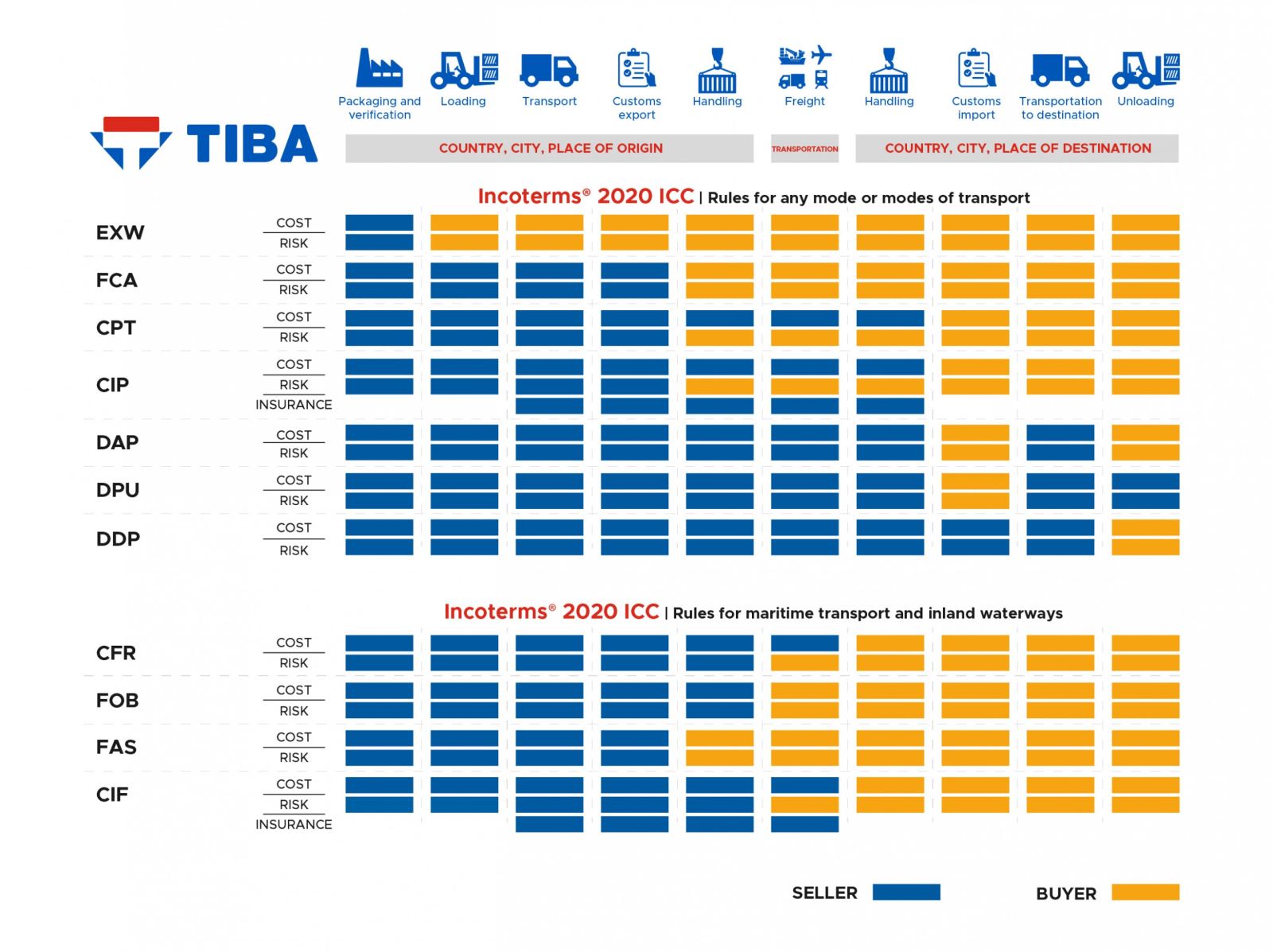 EXW | Ex Works
If the seller wants to export but lacks the ability to handle tasks such as customs procedures, transportation, insurance, etc., due to lack of export experience, they should propose an EXW contract. Under this condition, the seller only needs to make the goods available at their premises, and the buyer will pay the invoice amount and arrange for pickup.
1.EXW means that the seller delivers the goods to the buyer when the goods are placed at the buyer’s disposal at a specified location (factory or warehouse), which may or may not be the seller’s premises.
2.For delivery, the seller does not need to load the goods onto a vehicle or handle customs export procedures.
3.Delivery occurs – risk is transferred – when the goods are placed at the buyer’s disposal (not yet loaded onto the vehicle).
4.EXW is the Incoterms condition that imposes the minimum responsibility on the seller.
5.EXW can be used with all modes of transport.
6.Delivery point = Named place: The delivery location is the same as the specified location.
FCA | Free CarrierIf the seller can handle customs export procedures, it is convenient for the seller to undertake this (bearing the additional cost of export duties) and propose an FCA contract. The seller often anticipates the export duties and includes them in the amount due from the buyer
Main points:1.FCA means the seller delivers the goods to the buyer in one of two ways:
When the specified location is the seller’s premises, delivery occurs when the goods are loaded onto a vehicle arranged by the buyer, or
When the specified location is elsewhere, delivery occurs when the goods are loaded onto the seller’s vehicle and at another specified location, ready to be unloaded from the seller’s vehicle and placed at the disposal of the carrier or another person appointed by the buyer
2.The specified location for delivery determines where costs and risks are transferred to the buyer
3.FCA requires the seller to complete customs export procedures.
4.For contracts using FCA, if a Bill of Lading with an “on board” notation is needed, FCA in Incoterms 2020 specifies that if agreed, the buyer must appoint the carrier to issue a Bill of Lading with an “on board” notation to the seller.
5.FCA can be used with all modes of transport.
6.Delivery point = Named place: The delivery location is the same as the specified location.
CPT | Carriage Paid ToIf the buyer wants to receive the goods under FCA terms but cannot handle the transportation, they may negotiate an agreement under CPT terms. The seller usually anticipates the transportation costs and includes them in the amount due from the buyer.
Main points:1.CPT means the seller delivers the goods to the buyer – and transfers the risk of the goods to the buyer when:
The goods are delivered to a carrier hired by the seller, or
The seller purchases the goods delivered in this manner to deliver to the buyer.
2.Once the goods are delivered to the buyer in this manner, the seller does not ensure that the goods will arrive in good and complete condition at the destination. Risk transfers from the seller to the buyer when the goods are delivered to the carrier
3.The seller must contract for the carriage of goods from the delivery point to the agreed destination.
4.CPT can be used with all modes of transport.
5.Delivery point ≠ Named place: The delivery location is different from the specified location.
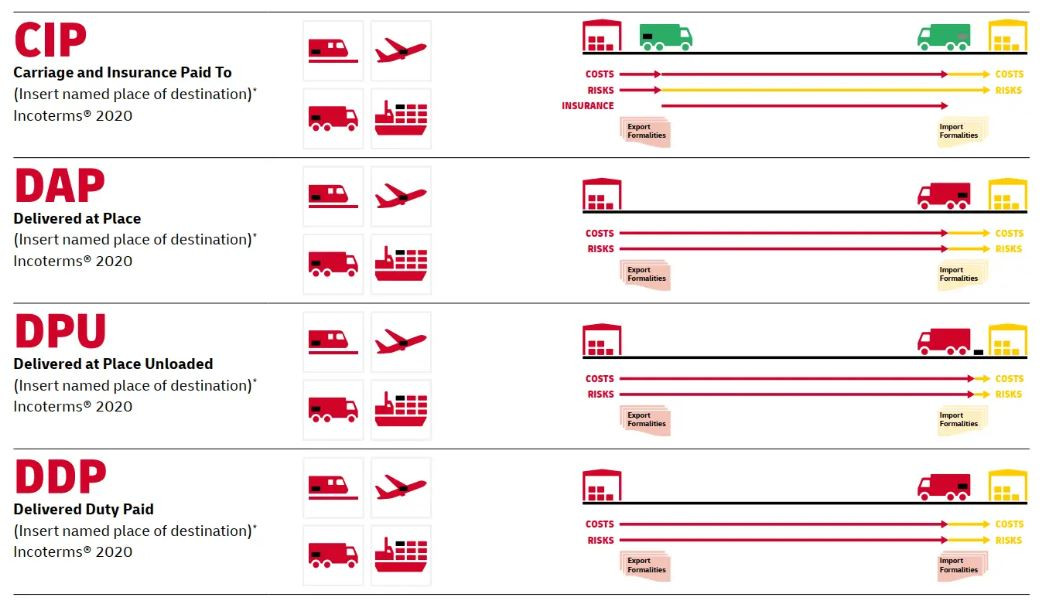
CIP | Carriage & Insurance Paid toIf the buyer wants to receive the goods under CPT terms but also needs the seller to purchase insurance for the shipment, the contract should be under CIP terms. The seller buys insurance and bears the cost, but the buyer bears the risk of loss or damage to the goods during transportation
Main points:1.CIP means the seller delivers the goods to the buyer – and transfers the risk of the goods to the buyer when
The goods are delivered to a carrier hired by the seller, or
The seller purchases the goods delivered in this manner to deliver to the buyer.
2.Once the goods are delivered to the buyer in this manner, the seller does not ensure that the goods will arrive in good and complete condition at the destination. Risk transfers from the seller to the buyer when the goods are delivered to the carrier.
3.The seller must contract for the carriage of goods from the delivery point to the agreed destination.
4.The seller must purchase insurance for the goods (insurance from the delivery point to at least the destination).
5.CIP can be used with all modes of transport.
6.Delivery point ≠ Named place: The delivery location is different from the specified location.
FAS | Free Alongside ShipIf the seller can also deliver the goods alongside the ship at the port of export, they should do so (bearing the additional costs and risks, and including these costs in the amount due from the buyer) and propose an FAS contract.
Main points:1.FAS means the seller delivers the goods to the buyer when:
The goods are placed alongside the ship specified by the buyer at the port of loading, or
The seller purchases the goods delivered in this manner to deliver to the buyer.
2.Risk of loss or damage to the goods transfers when the goods are placed alongside the ship, and the buyer bears all costs from that point.
3.FAS requires the seller to complete customs export procedures.
4.FAS is used with sea transport.
5.Delivery point = Named place: The delivery location is the same as the specified location.
FOB | Free On BoardIf the seller can also safely load the goods onto the deck of the ship at the port of export, they should do so (bearing the additional costs and risks, and including these costs in the amount due from the buyer) and propose an FOB contract.
1.FOB means the seller delivers the goods to the buyer when:
The goods are placed on the deck of the ship specified by the buyer at the port of loading, or
The seller purchases the goods delivered in this manner to deliver to the buyer.
2.Risk of loss or damage to the goods transfers when the goods are placed on the deck of the ship, and the buyer bears all costs from that point.
3.FOB requires the seller to complete customs export procedures.
4.FOB is used with sea transport.
5.Delivery point = Named place: The delivery location is the same as the specified location.
CFR/ CNF/ C+F/ C&F | Cost and FreightIf the seller can also arrange the shipping, they should do so (bearing the additional costs to hire the ship to the import port, and including these costs in the amount due from the buyer – without bearing additional risks) and propose a CFR contract.
Main points:1.CFR means the seller delivers the goods to the buyer when:
The goods are placed on the deck of the ship, or
The seller purchases the goods delivered in this manner to deliver to the buyer.
2.Risk of loss or damage to the goods transfers when the goods are placed on the deck of the ship; at that moment, the seller has fulfilled their delivery obligation regardless of whether the goods arrive at the discharge port in good and complete condition.
3.With CFR, the seller does not bear the responsibility to purchase insurance for the goods; hence the buyer arranges insurance.
4.The seller must contract for the carriage of goods from the delivery point to the designated port.
5.CFR is used with sea transport.
6.Delivery point ≠ Named place: The delivery location is different from the specified location.
CIF | Cost, Insurance & FreightIf the seller can also purchase insurance for the shipment when transported by sea, they should do so (bearing the additional costs to purchase insurance and including these costs in the amount due from the buyer) and propose a CIF contract.
Main points:1.CIF means the seller delivers the goods to the buyer when:
The goods are placed on the deck of the ship, or
The seller purchases the goods delivered in this manner to deliver to the buyer.
2.Risk of loss or damage to the goods transfers when the goods are placed on the deck of the ship; at that moment, the seller has fulfilled their delivery obligation regardless of whether the goods arrive at the discharge port in good and complete condition.
3.With CIF, the seller is responsible for purchasing insurance for the goods.
4.The seller must contract for the carriage of goods from the delivery point to the designated port.
5.F is used with sea tran.
6.Delivery point ≠ Named place: The delivery location is different from the specified location.
DAP | Delivered At PlaceIf the buyer lacks the ability or experience to bring the goods to their domestic import location, the seller can take on this additional task (including the cost in the amount due from the buyer) and propose a DAP contract
Main points:1.DAP means the seller delivers the goods to the buyer – and transfers the risk of the goods to the buyer when the goods are placed at the buyer’s disposal on the transport vehicle and ready for unloading at the designated destination.
2.The seller bears all risks of transporting the goods to the designated destination. Risk of loss or damage to the goods transfers to the buyer at the delivery point.
3.All costs incurred before the delivery point are borne by the seller, and all costs after the delivery point are borne by the buyer.
4.The seller must contract for the transport of goods to the designated place.
5.DAP can be used with all modes of transport.
6.Delivery point = Named place: The delivery location is the same as the specified location.
DPU | Delivery at Place UnloadedIf the buyer lacks the ability or experience to bring the goods to the import warehouse and also to unload them from the transport vehicle, the seller can take on this additional task (including the cost in the amount due from the buyer) and propose a DPU contract
Main points:1.DPU means the seller delivers the goods to the buyer – and transfers the risk of the goods to the buyer as soon as the goods are unloaded from the transport vehicle and placed at the buyer’s disposal at the designated place
2.The seller bears all risks of loss or damage to the goods in transporting them to the designated place and unloading them. DPU is the only Incoterms condition that requires the seller to unload the goods at the destination (the seller bears the costs and risks of unloading).
3.All costs incurred before the delivery point are borne by the seller, and all costs after the delivery point are borne by the buyer.
4.The seller must contract for the transport of goods to the designated place.
5.DPU can be used with all modes of transport.
6.Delivery point = Named place: The delivery location is the same as the specified location.
DDP | Delivered Duty Paid – Giao đã trả thuếIf the buyer lacks the ability or experience to handle customs import procedures for the shipment, the seller can take on this additional task (including the import duty amount in the amount due from the buyer) and propose a DDP contract
Main points:1.DDP means the seller delivers the goods to the buyer when the goods have completed the customs import procedures and are placed at the buyer’s disposal on the transport vehicle, ready for unloading at the designated place.
2.The seller bears all risks of loss or damage to the goods in transporting them to the designated place.
3.All costs incurred before the delivery point are borne by the seller (including customs import procedures), and all costs after the delivery point are borne by the buyer.
4.The seller must contract for the transport of goods to the designated placeđịnh.
5.DDP can be used with all modes of transport.
6.Delivery point = Named place: The delivery location is the same as the specified location.